 Capo
CapoTroubleshooting
When Capo cannot find your audio, when another extension has the tab, and when it runs but sounds wrong.
Troubleshooting: media detection and page access
“Nothing’s playing yet” — what should I try first?
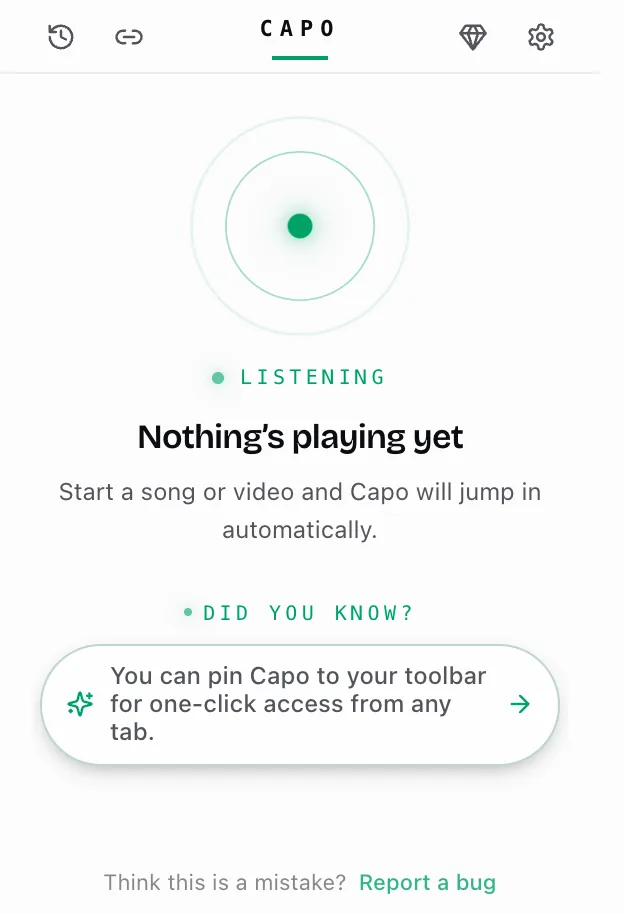
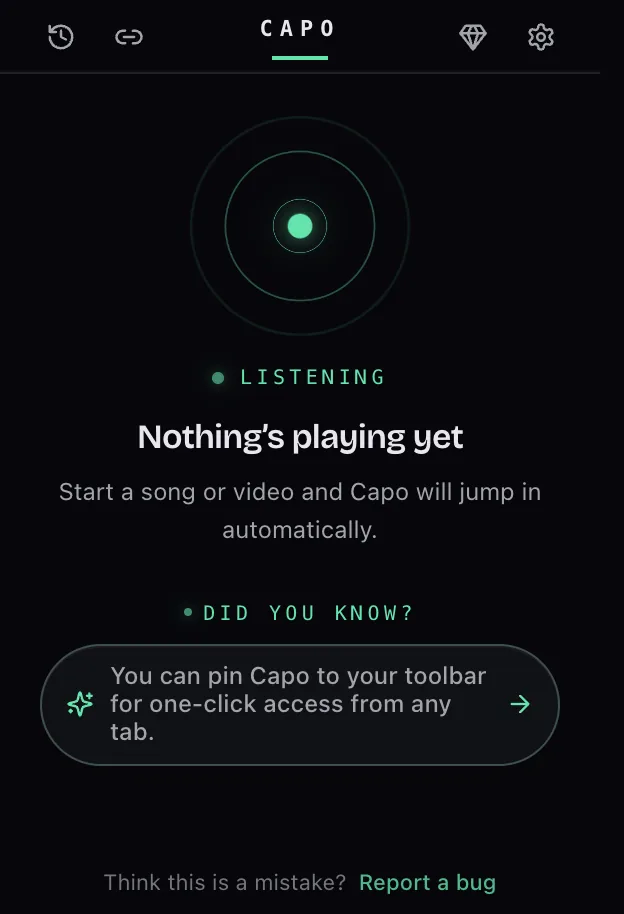
It means Capo is connected but hasn't heard any audio yet — press play.
The page is supported and Capo's connection is live; nothing is simply playing. Under the pulsing Listening dot it adds: Start a song or video and Capo will jump in automatically.
- Start playback on the page.
- Controls should appear automatically — no need to close and reopen the popup.
- Still stuck? Tap Report a bug at the bottom of the screen.
This is deliberate — Capo only connects its engine once an element actually starts playing.
- Routing audio through Capo’s engine is the expensive part, so it happens only on the first real play — Capo never touches media you never play.
- Sites also preload silent dummy clips for ads and sentinels; those never produce real playback, so Capo ignores them.
A refresh re-arms Capo — it doesn’t break it, you just need to press play again.
- Capo’s scripts reload with the page, before any audio exists.
- The refresh stops playback, so you land on Nothing’s playing yet.
- Press play — saved settings return once the track is identified.
“Capo cannot find audio on the page.”
A few sites skip real audio elements entirely, so Capo falls back to a reduced mode.
Capo normally finds audio by detecting elements once they play. Sites like QQ Music and Pandora decode straight to Web Audio with no element — Capo then falls back on the tab’s audible signal instead.
- Pitch and Volume stay live.
- Speed, the loop and the transport are greyed out.
“Capo does not work when the tab is muted.”
Muting the tab doesn’t turn Capo off — it keeps working, you just can’t hear it.
Capo keeps detecting the track and applying your settings while muted. One nuance: when Capo’s own volume sits at 0, Capo still treats the tab as audible, so muting from inside Capo never makes your controls vanish.
Unmute and your pitch and speed are already waiting.
“Capo can’t run on this page” — what does it mean?
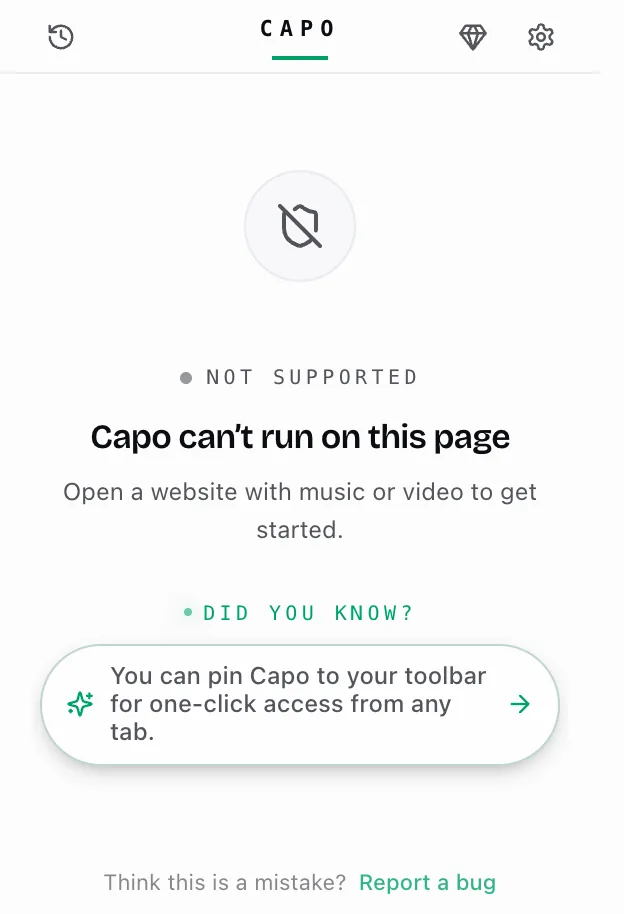
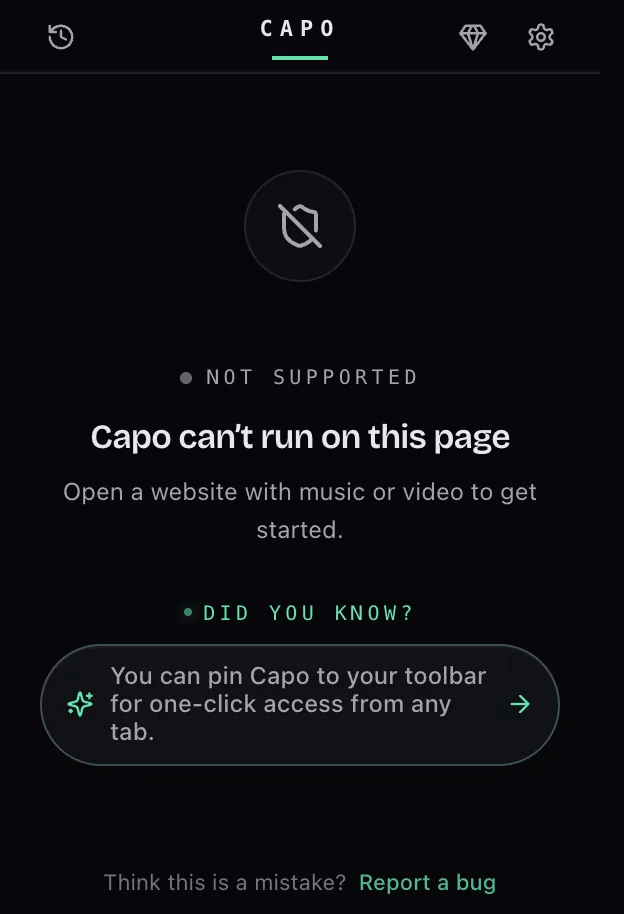
Capo can’t run on this page means the browser blocks every extension here — that’s policy, not a Capo bug.
There’s no permission you can grant to change it. It covers browser-internal pages, extension stores, view-source, data: and javascript: URLs, and local files. The screen adds: Open a website with music or video to get started.
Capo’s unsupported list covers:
- chrome://, chrome-extension://, chrome-search://, chrome-untrusted://
- edge://, brave://, opera://, vivaldi://
- about:, devtools://, view-source:
- chrome.google.com/webstore and chromewebstore.google.com are both unsupported.
- So are the Edge Add-ons and Firefox Add-ons stores.
You’ll get the Capo can’t run on this page screen there. It’s browser policy, and no permission unlocks it.
“Capo works on YouTube but not on another site.”
A few things genuinely differ per site — it isn’t one single cause.
- Some pages block every extension — you’ll see Capo can’t run on this page.
- Some have a strict security policy that blocks Capo’s WebAssembly engines, so it quietly drops to the lightweight one.
- Some hand their audio to another extension first — that’s Another extension has this tab.
“Capo does not work in incognito/private mode.”
Chrome blocks extensions in incognito until you allow each one.
- Open Extensions → Manage extensions.
- Select Details on Capo.
- Turn on Allow in incognito.
That's the whole fix in almost every case. Capo adds no incognito rules of its own, so once Chrome lets it run there it behaves exactly as it does in a normal window — including your saved settings, which are shared between the two.
Troubleshooting: extension conflicts
“Another extension has this tab” — what does it mean?
Another extension claimed this tab’s audio first — only one extension can control a given element.
A page can hand each audio element to one extension’s audio engine — first come, first served, and the browser refuses everyone after. The screen says so: Capo can’t change this tab’s pitch or volume while another audio extension controls it. Turn that extension off and reload.
- Volume boosters, equalizers, pitch shifters, and some media controllers all qualify.
- Whoever claims the audio element first keeps it — there’s no sharing.
Capo spots the refusal and shows Another extension has this tab rather than pretending your sliders still work.
“Another audio extension is blocking Capo.”
Use the conflict screen’s two buttons — disabling alone isn’t enough, you also need to reload.
- Tap Manage to open chrome://extensions in a new tab and switch the other extension off.
- Tap Reload to reload the tab so Capo can retry its connection.
The reload really is required — once Capo has been refused, that verdict sticks for the rest of the page’s life.
Bisect it — disable other audio extensions one at a time and reload between each.
If the conflict screen is gone and your sliders bite, you’ve found the culprit.
Troubleshooting: pitch, speed, volume, and sound quality
“Pitch shifting sounds unnatural at extreme values.”
The further you push pitch, the more the engine has to invent — that’s expected at extremes.
Capo’s dial reaches ±12 semitones by default; Pitch range in Settings widens it to ±36 or ±48, where artefacts get obvious fast.
- Try a smaller shift first.
- Raise Audio quality — Med is the strongest free tier; on Pro, High is the richest engine.
Sounds like a chipmunk? That’s pitch shifted well up — check the Pitch dial, not Speed.
- Check the Pitch dial and the Fine control.
- Use the pitch reset — it zeroes both in one click, since they’re one knob conceptually.
Speed alone won’t cause this: Capo keeps tempo and pitch apart, unless you’ve switched varispeed on, which couples them like tape.
“Speed sounds strange at very slow or very fast values.”
That’s the browser’s own playback-rate stretching, not Capo’s engine — it gets rough at extremes.
- The slider runs 0.25×–3× by default.
- Speed range in Settings pushes the ceiling to 8×, which sounds rougher still.
- Some sites also fight the rate change, so Capo re-applies it.
“Audio distorts when I boost the volume.”
Boosting past 100% adds real gain on an already-mastered mix, so loud peaks clip.
- Back the boost off until it cleans up.
- Raise your system volume instead of Capo’s.
Capo’s slider tops out at 300% by default; Volume range in Settings lifts the ceiling to 600% — plenty of rope.
Audio still too quiet even at 300%? That isn’t actually Capo’s limit — the ceiling goes higher in Settings.
- In Settings, raise Volume range from 300% to 600%.
- Past that, raise your device and OS volume instead of Capo’s.
“Audio crackles or lags.”


A busy machine can starve the live pitch-shifting thread, causing crackles or gaps.
- Open Settings.
- Drop Audio quality one tier down and test again.
As the setting itself puts it: Low is easiest on your device; Med is a good default; High sounds the richest but can feel heavier on slower machines. (High is the Pro tier.)
Capo loads its engine lazily, so the very first control nudge can lag while it lands.
- The worklet only loads the first time a frame actually plays something.
- Some sites also fight Capo’s speed changes and have to be overridden each time they push back.
Reload the tab — it usually settles both.
Troubleshooting: loops and playback controls
“I can’t set my loop.”
Work down this list.
- Is Capo's main switch on, and is something actually playing?
- Greyed-out Loop card? The site plays through Web Audio with no media element (QQ Music, Pandora) — there's no timeline to loop against.
- Only one button greyed? The playhead's within a quarter-second of the other point. Move it and retap.
On a live stream, the loop still works — only the seek bar is missing.
Tap A and B and Capo wraps you back as usual. What's missing is the seek bar: a live stream has no fixed timeline, so Capo shows a static LIVE bar instead, with no scrubbing and no drag handles. Rewind and fast-forward keep working.
Use the A/B buttons and the steppers, and keep the loop inside the part the stream still holds.
“Playback keeps pausing at the loop start.”
That's count-in — it's switched on, and it's deliberate.
At the top of every repeat Capo pauses for a beat so you can reset your hands, then resumes on its own.
Tap the timer button in the loop pill to turn count-in off — the loop then runs straight through.
The pause length lives in Settings: 1s, 2s, 3s or 5s.
“Play, rewind or seeking doesn’t work from Capo.”
Capo's play, rewind and seek buttons drive the element it detected on the page — two things can break that.
- On Web Audio sites with no media element (QQ Music, Pandora) the whole player strip is greyed out — use the site's own button.
- Otherwise the browser may be refusing to start playback on its own — press play on the page once, and Capo takes it from there.
Those buttons move the playhead on the element Capo detected.
- On a live stream they still work, but only within the stretch the stream keeps buffered.
You can change the jump size (the skip interval) in Settings.
Where Capo's bar can't help, the site's own scrub bar still works.
“Keyboard shortcuts work in Capo but not on the page.”
They're two separate sets of shortcuts.
- Popup: bare keys — A, B, L, C.
- Page: Alt/Option combos — Alt+A, Alt+B… with their own on/off switch in Settings.
- Page shortcuts stand down while you're typing in a search box or comment field.
- Play/seek ship unbound on the page, because sites own those keys.
Rarely an issue — Capo listens before the page does.
Page shortcuts default to Alt/Option combos precisely so they don't collide with what sites claim. The one real gap is a player tucked inside an embed while the outer page holds focus — click the player once and the keys land.
Rebound a shortcut to a bare key? That's when a site can win.
Troubleshooting: saved settings
“My settings did not save after I closed the browser.”
Saved tracks survive a browser restart — so something blocked the save.
- Check Auto-save is on: Settings → Data & privacy
- Confirm something actually changed — a track back at default values isn't stored
- Check whether Capo could identify the track: does it show up in History?
- Remember History holds 500 tracks; the oldest fall off
“My settings reset when the next song auto-played.”
That is Capo doing its job — settings belong to the track, not the tab.
- When a new song starts, Capo loads that song's saved settings
- If it has never seen the song before, it loads normal settings instead
- The tweak you made to the last song does not follow you into the next one
- Nudge the new track's pitch or speed and it gets saved too, ready for next time
Spotify and SoundCloud keep one address across a whole queue while the music changes underneath. When the next song starts, Capo spots the new track and swaps in whatever’s saved for it, or falls back to defaults.
“Different songs on the same website use the same settings.”
Not a per-site rule — Capo can't tell those two songs apart.
Every track is meant to get its own entry.
- Tracks are identified from the info a site publishes
- Where a site publishes none, Capo falls back to the page address
- Two songs sharing one address share one entry
- Sites like YouTube, Spotify Web and SoundCloud report each track properly, so they stay separate
Different sites give Capo different amounts of information to work with.
Do report the site to us and we will take a look.
“What should I try before contacting support?”
Work through this checklist before reaching out.
- Get the media playing before you open Capo
- Check Auto-save is on — Settings → Data & privacy
- Move a control, then look for the track in History
- Refresh the page and try once more
- Try another site to narrow it down
Still stuck? Hit Send feedback in Settings and tell us which site.
Troubleshooting: Capo Pro & the workspace
“My clip won’t play — it’s greyed out.”Pro
Its on/off switch is off — flip the switch on the clip row.
A dimmed clip row means the clip is disabled: its play button and drawer are inert until you turn the switch back on. If a clip is enabled but still won’t play, check it isn’t shorter than the quarter-second minimum and that its start and end still sit inside the track — open the drawer and retype the times if they drifted.
“Marker already here” — why won’t Capo add my marker?Pro
There’s already a marker within the minimum spacing at the playhead.
Capo keeps markers a small gap apart so two can’t stack on the same instant, and the + Add-marker button says so rather than dropping a duplicate. Move the playhead a moment earlier or later and add it there, or just rename/redrag the marker that’s already sitting on that spot.
“The speed trainer won’t start, or it won’t speed up.”Pro
Work down this list.
No loop yet? The trainer ramps a loop, so set an A–B loop first — the trend-up button lives on the loop card. Start equals Target? There’s nothing to climb; lower Start or raise Target. Seems stuck? It only steps up after Every repeats (two by default), so give it a couple of passes at each speed. Paused? A live session can be paused — the speed holds where it is until you resume. Ending the session returns playback to your normal speed.
“The equalizer isn’t changing the sound.”Pro
Two things to check: the site’s audio, and whether the bands are actually doing anything.
A few sites play through Web Audio with no real media element behind them (some radio and game-music players). The equalizer still works there — it sits in the same audio path as Volume — even though Speed and the loop drop out on those pages. So the usual fix is simpler: make sure the bands aren’t all sitting flat at 0 dB and that you’re listening to a range a band actually covers — a small boost on one band is easy to miss on a busy mix.
“Sign-in didn’t stick, or I keep getting signed out.”Pro
Sign-in opens a capotune.com tab — let it finish, then come back to Capo.
When you tap Sign in, Capo opens a tab to sign you in and the popup closes on focus — that’s expected, not a failure. Once the tab confirms, reopen Capo and your account shows. If it didn’t take, tap Sign in again, and make sure you’re signing in with the same account you bought Pro with. A session can also expire after a long time — just sign in again to refresh it.
“The workspace is laggy, or the audio crackles.”Pro
Give your machine less to do: switch Audio quality down, or turn on Low latency mode.
High audio quality sounds richest but is the heaviest — on a slower machine, dropping it to Med in Settings often clears stutter. Low latency mode (under Audio & playback, on the High tier) trims the delay, though it’s off while formant shifting is active. Running several heavy effects at once — a big formant shift plus reverb plus the vocal reducer — is the most demanding combination, so ease one off if the audio breaks up.