 Capo
CapoWhy the pitch dial stops at twelve
Twelve semitones is one octave. Every ordinary reason to change the key of a song lands inside it — fitting a song to a voice, moving to a friendlier key, matching a record tracked a half step down, dropping a bassline into a range you can play.
How far can you transpose a song?
The range widens to ±36 or ±48 in Settings, and it is opt-in rather than default for one reason: the same physical dial travel would then cover four times the ground. Landing exactly on −1 becomes fiddly for everyone, to serve the few people dropping a drum loop three octaves. Precision at the centre is worth more than reach at the edges.
Which semitone shifts are actually useful?
| Move | Semitones | Why you would |
|---|---|---|
| Half step | ±1 | A great many rock records were tracked a half step down |
| Whole step | ±2 | Common for wind instruments |
| Fourth / fifth | ±5 / ±7 | Standard key relationships |
| Octave | ±12 | Same note, playable range |
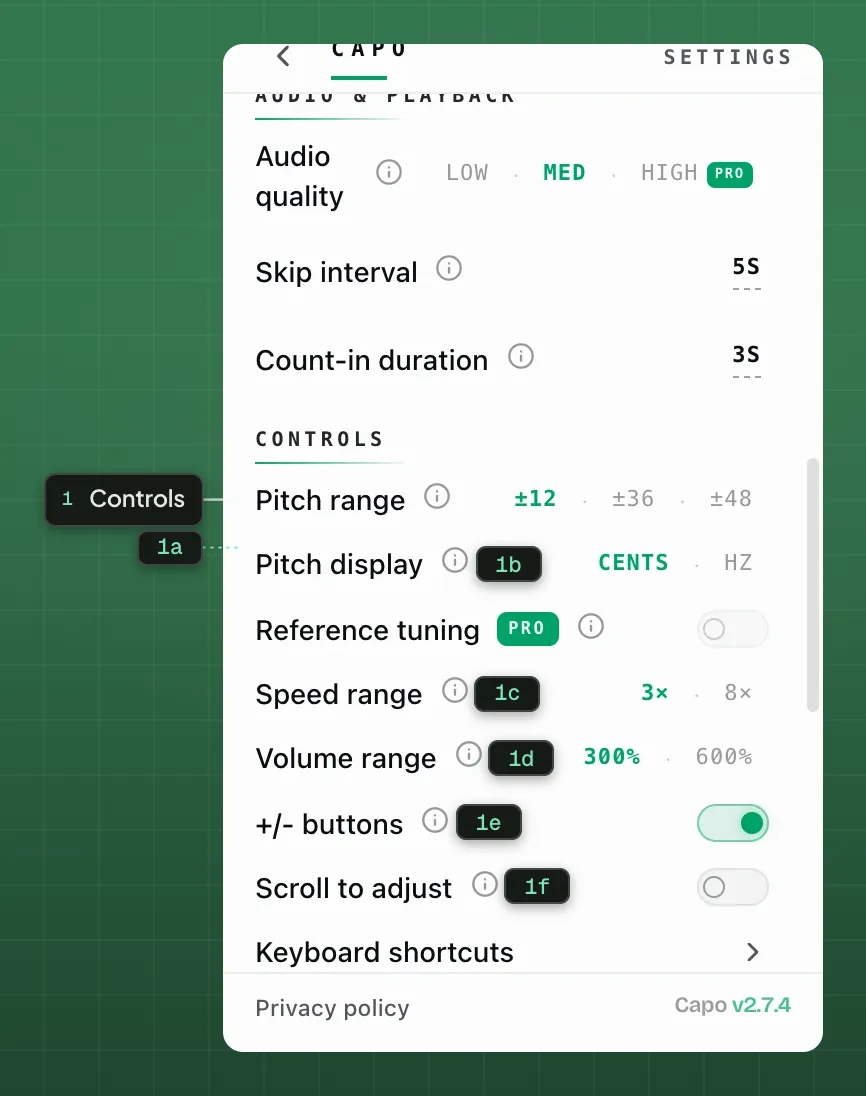
- 1Controls
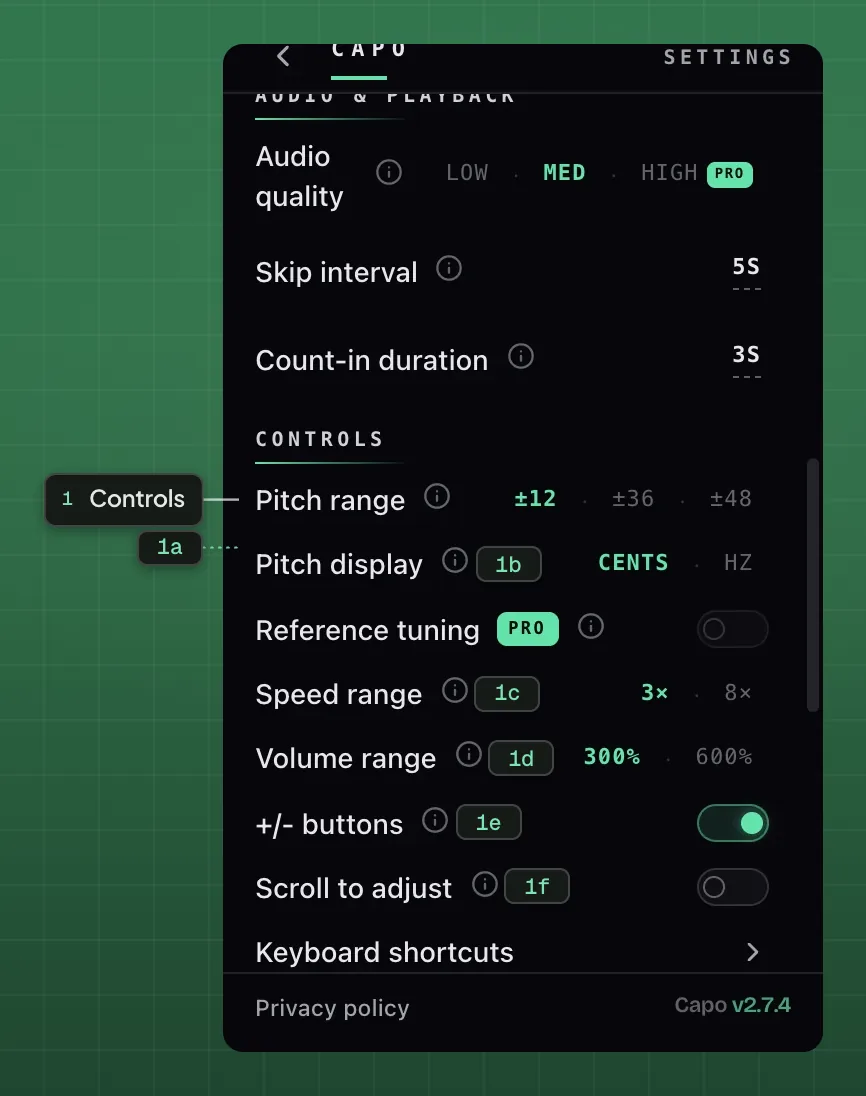
- 1aPitch range1bPitch display1cSpeed range1dVolume range1e+/- buttons1fScroll to adjust
Why the maximum is 48 semitones
It stops at 48 because that is where the audio gives up. Neither Signalsmith nor Rubber Band shifts cleanly past about four octaves; beyond that the grain machinery has so little original material left that the output is more artefact than signal. A control that went further would be offering you a way to make noise.
Does the pitch range apply per tab or everywhere?
One thing we got wrong first: an early build let the wide range apply per tab. It sounded flexible and was a support problem, because people would widen it once, forget, and later find the dial behaving differently on one site than another with nothing on screen to explain why. Ranges are global now. Less clever, much easier to reason about.
Fragen
How many semitones can you shift a song?
What is the maximum pitch shift?
Can you shift pitch by less than a semitone?
Does a wider pitch range apply to one tab or all of them?
Why is the pitch range not just set to the maximum by default?
Weiterlesen
Why Capo ships three time-stretch engines instead of one
Audio quality picks between SoundTouch, Signalsmith and Rubber Band. What each one costs you, and when to change it.
Why two guitars a few cents apart beat against each other
That slow wobble when two players are nearly in tune is not a metaphor. It has a frequency, and you can count it.
How to change the pitch of a YouTube video
Shift any video up or down in semitones without touching the speed, on the player you already use. Free, and nothing is uploaded.