 Capo
CapoWhy slowed audio sounds underwater
Slowing a recording the old way drags the pitch down with it, because you are playing the same waveform more slowly. Keeping the pitch fixed means rebuilding the sound from short overlapping grains, and when those grains do not line up you hear smearing, a metallic edge, or a voice that sounds submerged.
- Play the demo below in Varispeed. Pitch falls with speed.
- Switch to Independent. Speed moves, pitch does not.
- The difference is what costs the artefacts.
“Slow it down” describes two different operations. They sound different, and most questions about pitch shifting come from expecting one and getting the other.
Two ways of slowing the same tone. Varispeed is tape: the pitch falls with the speed. Independent is what Capo does by default: the speed moves and the pitch stays. Move the speed slider in each mode and watch the resulting pitch.
Synthesised live in your browser with the Web Audio API — the same technology Capo uses. Nothing is downloaded.
Varispeed: the honest one
Play a record at half speed and every frequency in it halves. Pitch is how often a waveform repeats per second, so halving the playback rate halves the repetition rate: an octave lower.
Tape does this. So does a turntable, and so does changing the sample rate. It sounds natural because it is what physically happens — and it is no use for practising along, because the recording is now in a different key from your instrument.
Time-stretching: the useful one
Holding the pitch steady means rebuilding the audio. The engine cuts it into grains a few tens of milliseconds long, then re-schedules them: spaced further apart to slow down, overlapped to speed up. Each grain still plays at its original rate, so the pitch stays put. Only the timing changes.
The grain boundaries are where it goes wrong. At every join, two pieces of waveform meet that were never adjacent; if they meet out of phase the result is a click, a smear or a faint ring. That happens thousands of times a second, and the accumulation is what people hear as watery, phasey or underwater.
Why it gets worse at extremes
At 0.9× the grains barely have to move, and the artefacts are inaudible. At 0.25×, each grain has to be stretched or repeated four times over, so there are four times as many joins and each one is under more strain. That is why the floor is 0.25× and not lower: past that point the errors stop being artefacts and start being the dominant sound.
| Speed | What you hear | Useful for |
|---|---|---|
| 0.9–1.0× | Nothing. It is transparent. | Comfortable listening |
| 0.6–0.8× | Clean on most material | Learning a part |
| 0.4–0.6× | Slight smear on cymbals and sustained vocals | Picking apart a fast run |
| 0.25–0.4× | Audible watery quality | Identifying one specific event |
Which is why there is a quality setting
Better grain placement costs processing. Capo ships three time-stretch engines and the Audio quality setting picks between them: the lightest is cheap and smears sooner, the heaviest holds together further down. Below about 0.5× the difference is obvious; above 0.8× you will struggle to hear it at all.
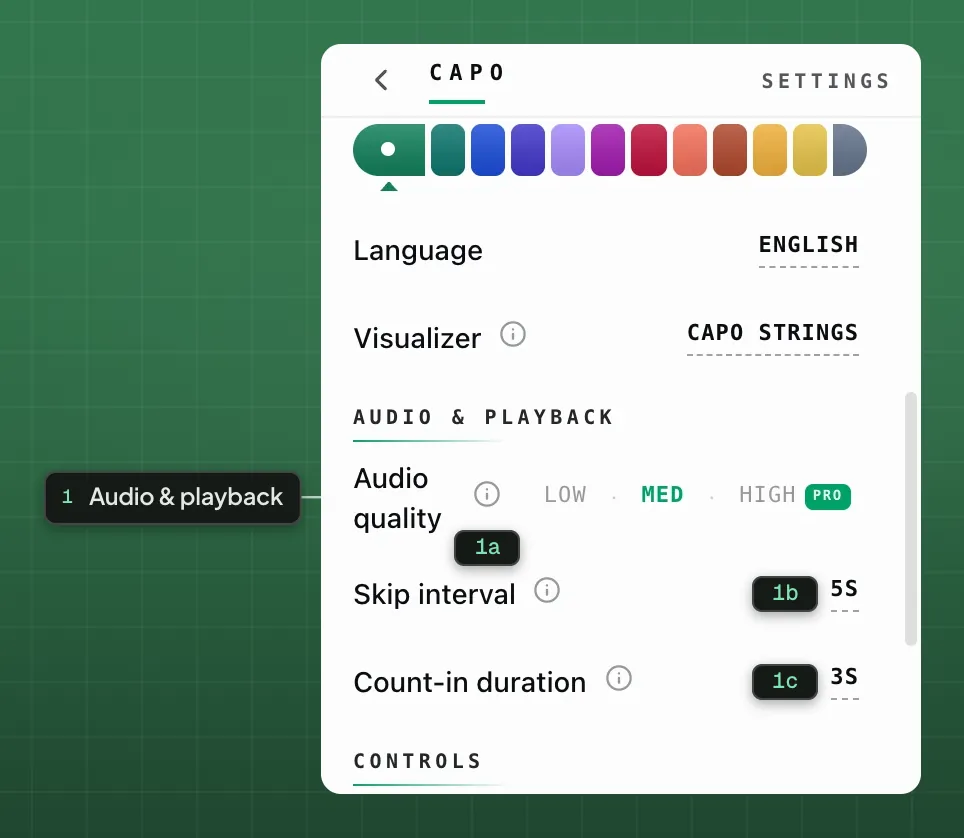
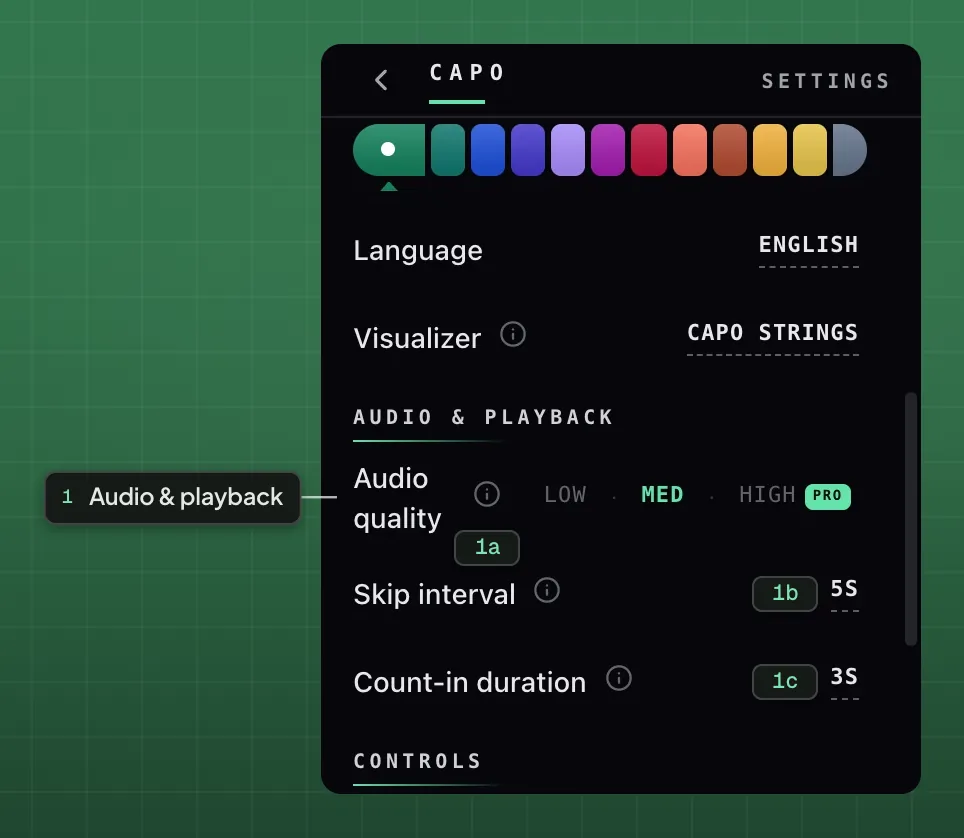
- 1Audio & playback
- 1aAudio quality1bSkip interval1cCount-in duration
The reasoning behind having three rather than one is in why there are three engines and not one.
Voices are the hard case
Voices suffer more than instruments. A voice carries resonances set by the size of the throat and mouth — formants — and listeners are sensitive to them because they encode how big the speaker is. Smear those and the change registers immediately, even when the listener cannot name it.
That sensitivity is also why transposing a voice needs a separate correction — covered in singing a song that sits four semitones too high.
Hear the difference for yourself.
Three engines, switchable · free, no accountTwo things this does not settle
It does not explain why some recordings survive slowing far better than others. Dense, loud, heavily limited masters have less room between transients and tend to smear earlier than sparse acoustic recordings, but that is a rule of thumb rather than a rule.
It also does not cover pitch shifting, which uses the same grain machinery in the opposite direction and has its own failure modes.
Fragen
Why does slowing a video normally lower the pitch?
How does Capo slow audio without changing the key?
Why does heavily slowed audio sound watery?
What is the lowest usable speed?
Weiterlesen
Why Capo ships three time-stretch engines instead of one
Audio quality picks between SoundTouch, Signalsmith and Rubber Band. What each one costs you, and when to change it.
How to transpose a song to fit your vocal range
Move the song, not your voice. The hard part is not the transposition, it is keeping the singer sounding like a person.
How to slow down a YouTube video without changing the pitch
Take any video down to a quarter speed to learn from it, while the pitch stays exactly where it was.