 Capo
CapoSettings, shortcuts & saving
What Capo remembers for each track, driving it from the keyboard, and the language and look of the panel.
Per-site settings and saved settings
What does Capo remember for each track?
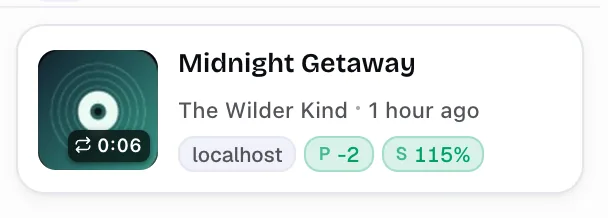
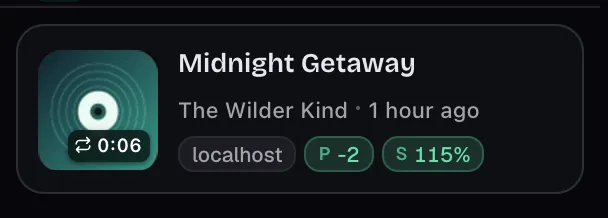
Capo saves per track, not per site — automatically, with no save button.
Your settings are stored against whatever is actually playing (song, video, episode), not the website it lives on. Two songs on one site each keep their own settings, and those settings follow the track wherever it turns up.
What gets remembered:
- Pitch — semitones and your cents fine-tune
- Speed
- Volume
- Your A/B loop
- Pro extras: formant, reverb, varispeed, clips, notes and markers
It also tucks away the title, artist, artwork and a link, so History can show you the track and reopen it in one click — everything you have saved lives there.
When it saves: about a quarter-second after you stop moving a control. Two things have to be true:
- Auto-save is on (Settings → Data & privacy; it is on by default)
- Capo can tell what track is playing
If everything is back at default with no loop or note attached, Capo drops the entry instead of storing a blank.
How do I remove saved settings for a site?
Per track rather than per site — remove entries from History instead.
- Open History
- Delete the entry you are finished with
To wipe the lot in one go, head to Settings → Reset → Clear history, which removes saved pitch, speed and volume for every saved track.
Do saved settings sync across devices?
Split answer: saved tracks stay local, app preferences sync.
- Saved tracks — pitch, speed, volume, loops, all of History — are stored locally in this browser and do not sync; per-track entries stack up fast, so they stay put
- App preferences — language, audio quality, pitch range, shortcut bindings, the EQ curve — ride the browser's synced storage, so they follow you to other devices on the same profile.
- Theme and accent save locally to the browser you set them in.
- Reset settings restores everything else, but deliberately leaves your language alone.
What happens to saved settings in incognito mode?
They're the same saves — incognito doesn't get a separate set.
First, Chrome only runs Capo in an incognito window if you allow it: open Extensions → Manage extensions, select Details on Capo, and turn on Allow in incognito.
Once it's allowed, Chrome shares extension storage between normal and incognito windows. So your existing saves are there, and anything you save in an incognito window is still there afterwards in normal browsing. Capo adds no incognito rules of its own.
Keyboard shortcuts
Does Capo support keyboard shortcuts?
Yes — two separate, rebindable sets of shortcuts.
- On-page shortcuts work while audio plays, with the popup closed.
- Popup shortcuts work while Capo's popup is open.
Both are listed and rebindable, and each scope can be switched on or off independently in Settings → Keyboard shortcuts.
- Open Capo and click the gear icon.
- Select Keyboard shortcuts.
- Use the switcher at the top to flip between On the page and In the popup.
- Browse by group: Playback, Pitch, Speed, Volume, and Loop — Effects and Markers join the list on Pro.
- Tap any row to rebind it, or hit Reset all to restore defaults.
Which shortcuts are bound by default?
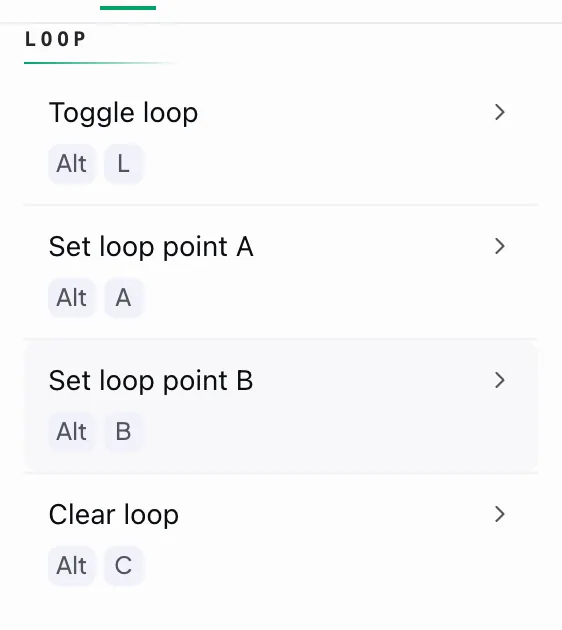
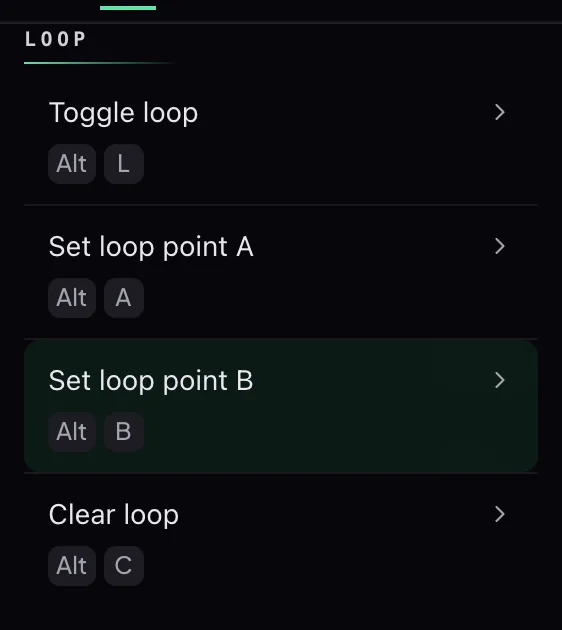
All four loop actions are bound by default.
- Set start (page / popup): ⌥A / a
- Set end (page / popup): ⌥B / b
- Toggle loop (page / popup): ⌥L / l
- Clear loop (page / popup): ⌥C / c
Toggling does nothing until both start and end points exist.
Play/pause and seek are bound in the popup, and unbound on the page by default.
- Play/pause (popup): Space
- Skip back/forward (popup): ← / → — jumps by your skip interval
On the page these ship unbound on purpose — sites already own those keys and Capo would rather not fight them. The rows are still there in Settings if you'd like to bind your own.
How do I change a shortcut?
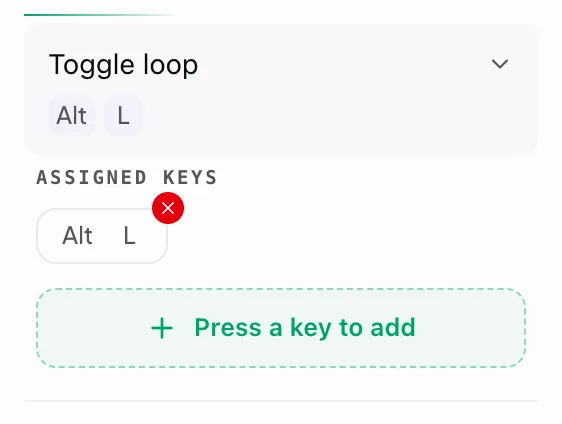
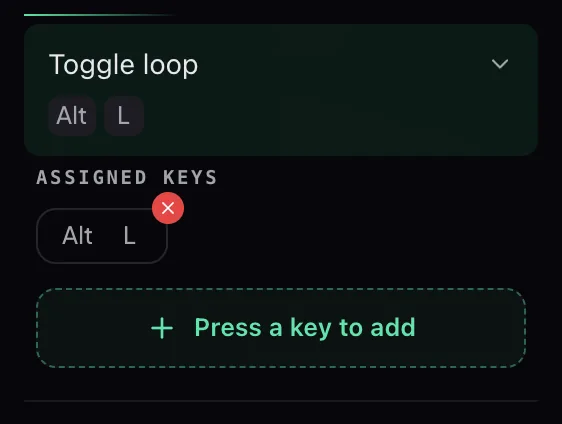
Only Capo's "open" shortcut lives in Chrome — the rest are edited inside Capo.
- Chrome shortcut: a single command that opens Capo from any tab. Chrome owns it, it has no default, and you assign it on Chrome's own shortcuts page.
- Capo's page and popup shortcuts: actually change pitch, speed, and loops. Set inside Capo's Settings.
Set your own — Capo ships this shortcut unassigned.
- In Capo, go to Settings → Keyboard shortcuts.
- On the top card, select Set shortcut (or Change shortcut).
- Chrome's own shortcuts page opens in a new tab — set your combination there.
Chrome sets the rules on that page: a shortcut has to include Ctrl or Alt, Shift is optional, and Ctrl+Alt combinations aren't allowed. On a Mac, Ctrl becomes Command. Chrome and system shortcuts always win, so a combination already in use won't reach Capo.
Why does a shortcut not work on some websites?
Usually one of four things.
- Your cursor is in a text field — Capo always steps aside there.
- Capo's toggle is off for that tab.
- That scope's switch is off in Settings.
- The player sits in an embedded frame while the outer page has focus — click the player once, then try again.
This matters most on Mac, where ⌥ plus a letter is supposed to type an accented character — Capo gets out of the way so it can.
Will Capo shortcuts conflict with YouTube, Spotify, or other website shortcuts?
Rarely — Capo's on-page defaults all use ⌥ (Option/Alt) combos that sites almost never claim.
They're matched by physical key position, so keyboard layout doesn't matter. Where a site does grab the same key, Capo listens first and stops the page from also acting.
Ctrl and ⌘ chords are always left alone for the browser.
Languages and appearance
Which languages does Capo support?
Capo's entire interface works in 52 languages.
That includes Español, Português, Français, Deutsch, 日本語, 中文, 한국어, Русский, हिन्दी and العربية — fully right-to-left — plus dozens more.
To change it:
- Open the popup and click the gear icon.
- Select Appearance → Language.
- Choose your language — each is listed in its own native name.
The change applies live — the popup re-renders instantly, nothing to reload.
Can I change the theme or appearance?
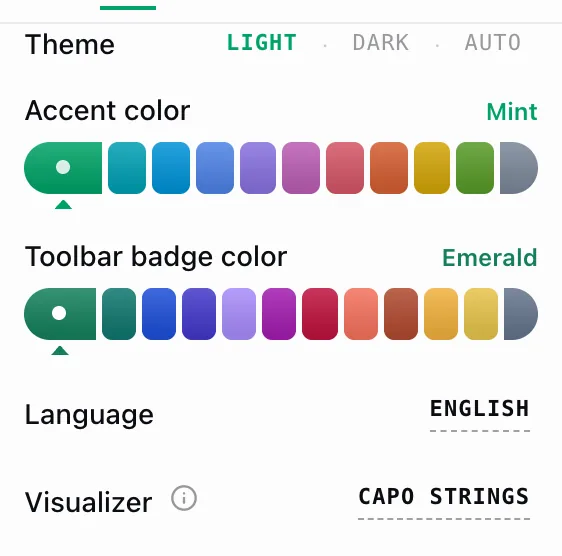
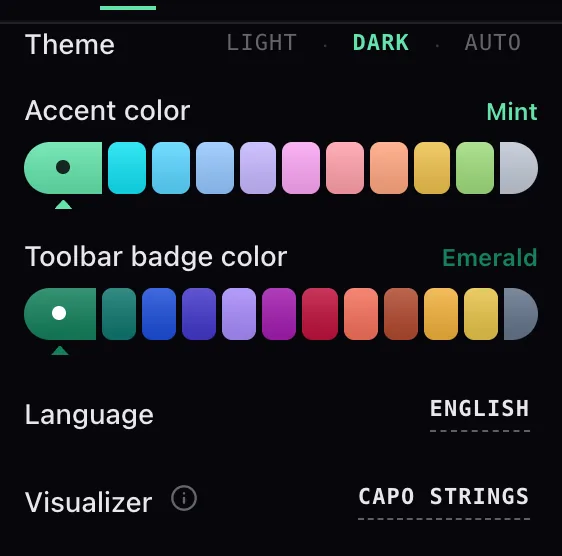
Yes — Settings → Appearance has five things you can customize.
- Theme — Light, Dark, or Auto
- Accent color — eleven swatches
- Toolbar badge color
- Language — 52 of them
- Visualizer — the ambient wave at the bottom of the popup that moves with the music; pick a style or switch it off