 Capo
CapoHow to practise a passage faster when you hit a speed wall
A passage that stalls at the same tempo for a week is rarely a speed problem. It is either a fingering that stops working above that tempo, or a schedule made of jumps too large to absorb. Neither is fixed by trying harder at the tempo that fails.
- Play it at 95% of the wall. If that fails too, the wall is lower than you think.
- Reduce the step to 2 or 3 percent, not 10.
- If it still will not move, change the fingering, not the tempo.
Everyone has a passage like this. Fine at 80%, fine at 85%, in pieces at 90%, every day for a fortnight. The instinct is to keep attacking 90%. That is usually wrong, and it is worth knowing why before spending another week.
First, find where the wall actually is
Play it at 95% of the tempo that defeats you. Not 90, not 85. If it fails there too, your wall is lower than you think and you have spent a week practising failure. If it holds cleanly, the wall is real and narrow, and the rest of this applies.
The step size is usually the problem
Most people climb in jumps of five or ten percent because those are round numbers. The body does not care about round numbers. A 3% step is about two clicks of a metronome at 120 bpm: small enough that each stage feels like the last one, which is the entire point. Ten percent feels like a new piece.
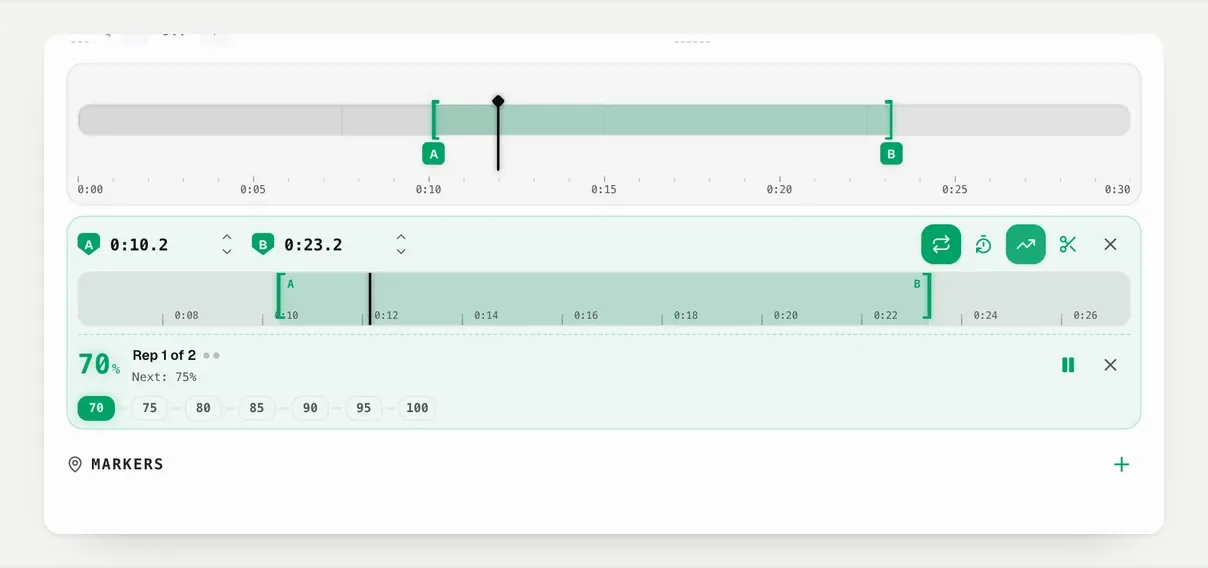
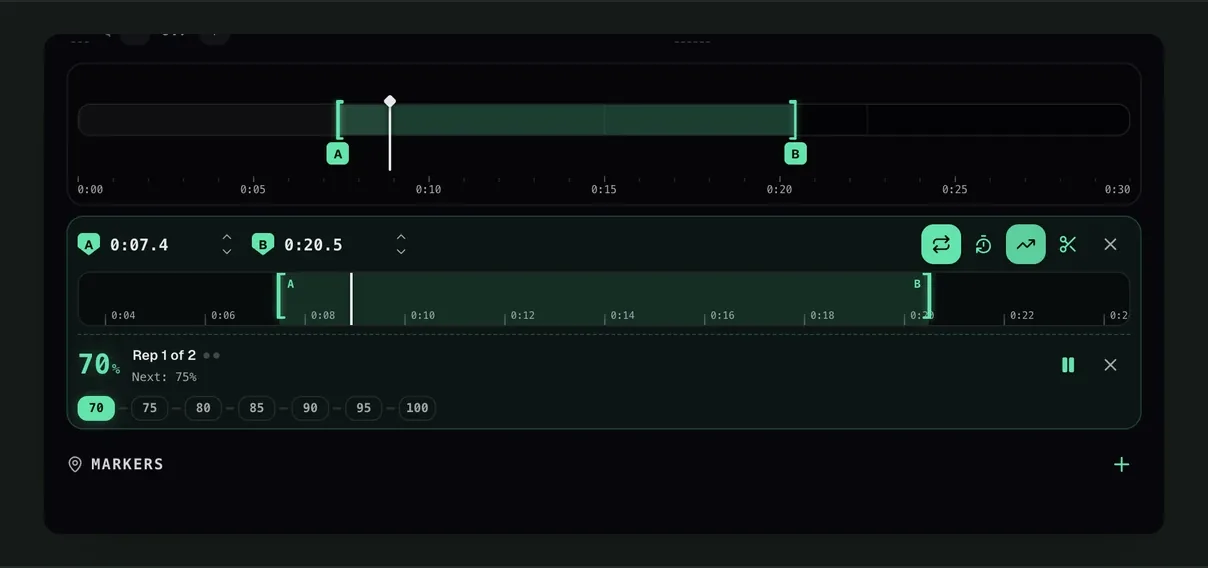
- Set Start below comfortableIf you can play it at 80%, start at 75%. The first stage should feel easy.
- Set Step to 2 or 3 percentYou want each stage to feel identical to the last one.
- Set Every to 3 or 4 repeatsLong enough to settle, short enough that the session is not an hour.
- Set Target above the wallA few percent past it. Not reaching it today is information, not failure.
When the fingering is the wall
Some fingerings work slowly and stop working quickly. A stretch that is comfortable at 70% may not have time to release at 95%. A position shift that is fine when you can look at it becomes impossible when you cannot.
The tell is a wall that does not move at all across a week of correct practice. Walls made of unfamiliarity move, slowly. A wall made of a bad fingering sits exactly where it was on day one. When you see that, stop drilling and re-finger.
Where the trainer runs
It runs on the loop, so set A and B first — ideally around the one beat that fails rather than the whole phrase, for the reasons in the bar you keep missing.
Let the tempo climb while you keep playing.
The speed trainer is part of Capo Pro · 7-day free trialWhere the trainer runs out
It will not make playable a passage you have not learned. The trainer raises tempo on something you can already play slowly and accurately; used on a passage you are still working out, it just moves the failure around.
It will not fix musical problems either. A phrase you do not understand rhythmically will not become clear at 96% having been unclear at 92%. Work the rhythm out slowly, by ear, first.
أسئلة
Why does my passage stall at the same tempo every day?
What step size should I use?
Can it go above full speed?
تابِع القراءة
The bar you keep missing is usually one beat
Looping a whole phrase means drilling the part you can already play. Narrow it until it fails again and the fault is a second long.
Why Capo ships three time-stretch engines instead of one
Audio quality picks between SoundTouch, Signalsmith and Rubber Band. What each one costs you, and when to change it.
How to learn a song by ear without naming a single note
You do not need perfect pitch or theory. You need a slow loop, one string, and a way of asking the recording yes-or-no questions.