 Capo
CapoThe bar you keep missing is usually one beat
When a passage keeps falling apart, the fault is rarely spread across the bar. It is one transition, usually under a second. Loop the whole phrase and you will drill the eighty percent you already own. Narrow the loop until it starts failing again and you have found the actual problem.
- Loop the phrase you cannot play. Play it four times.
- Halve the loop. Keep the half that still fails.
- Halve again, until it is about one beat wide.
There is a kind of practice that feels productive and is not: a loop around eight bars, thirty repetitions, and no improvement at the one moment that keeps going wrong. You are rehearsing your competence. The bar that beats you is in there, surrounded by material you already own, and every repetition spends most of its effort on that material.
Bisect it, the way you would a bug
The method comes from debugging and works for the same reason: the fastest way to find a fault in a long sequence is to cut the sequence in half and ask which half still fails.
- Set the loop wideAround the whole phrase you cannot play. Four repetitions. Note which half breaks down, not precisely where.
- Cut it in halfKeep the half that failed. Four more repetitions.
- Cut againAnd again. Three or four cuts take an eight-bar phrase down to roughly a beat.
- Stop when it stops failingThe last loop that still defeats you is the real problem. Everything wider was scenery.
Most people are surprised how small the answer is. An eight-bar run that has been unplayable for a week usually reduces to one position shift, a fingering that was never decided, or a single note being reached for late.
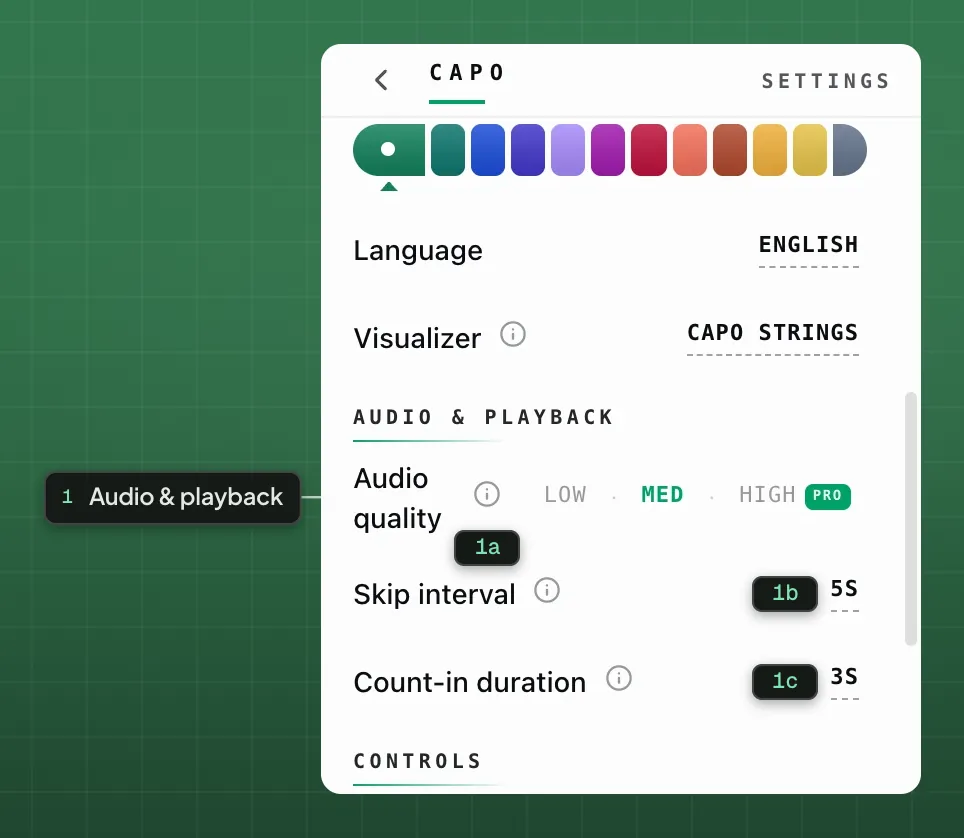
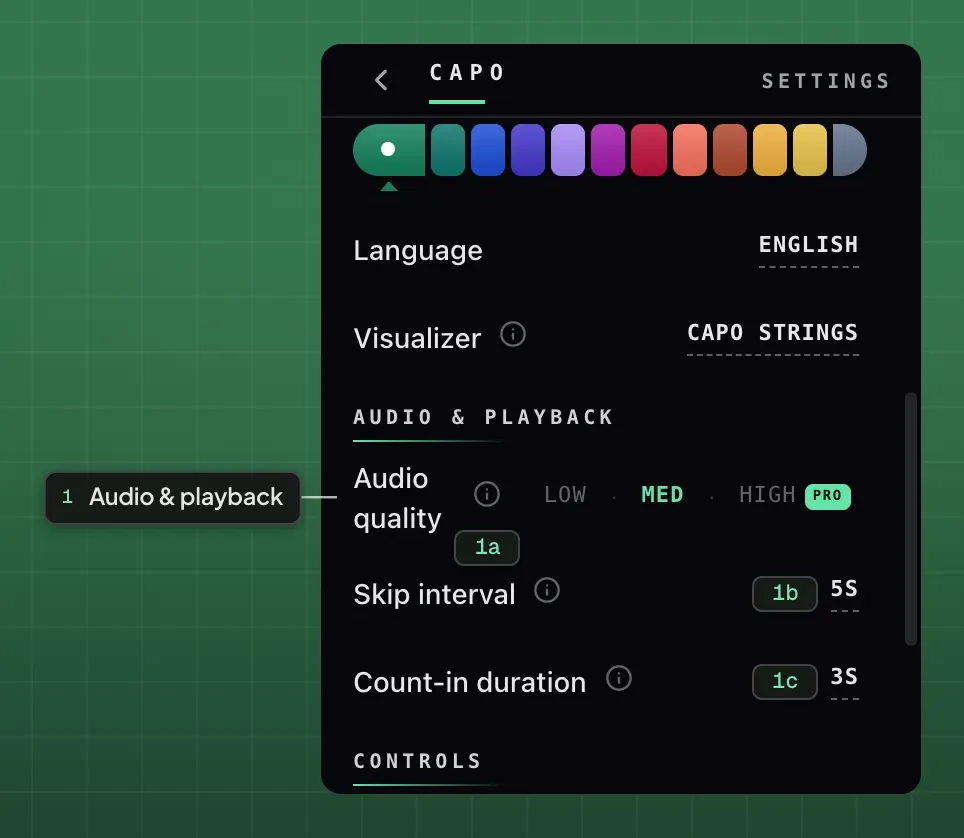
- 1Audio & playback
- 1aAudio quality1bSkip interval1cCount-in duration
Then widen back out in one move
Once the beat is solid, do not creep outwards a note at a time. Go straight back to the full phrase. If it holds, you were right about the fault. If it collapses, you narrowed onto the wrong beat, which is useful information that took a minute instead of a week.
The usual failure: the beat is fine alone but falls apart in context. That means the problem is the approach to the beat, not the beat. Move the loop one beat earlier and repeat.
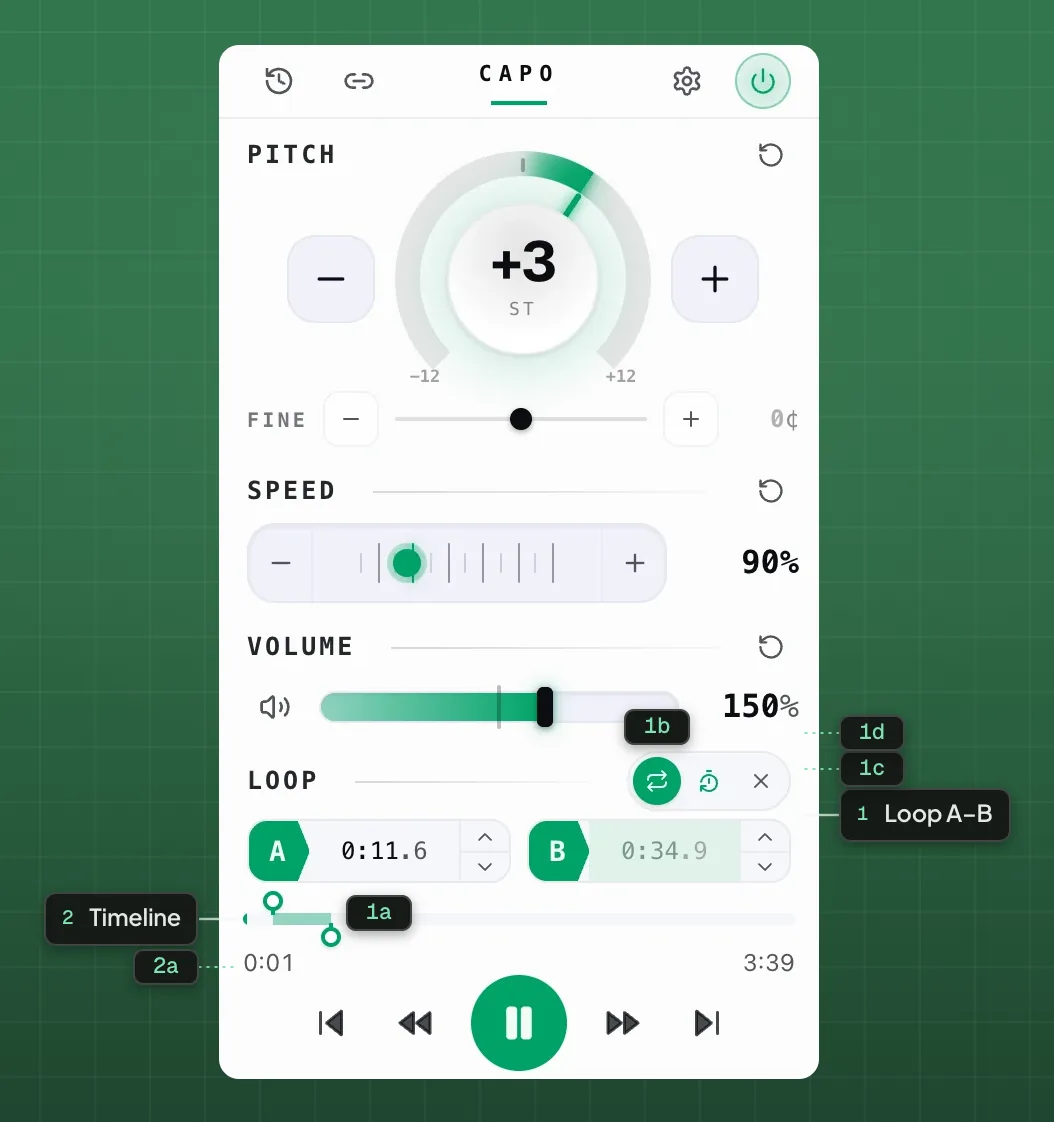
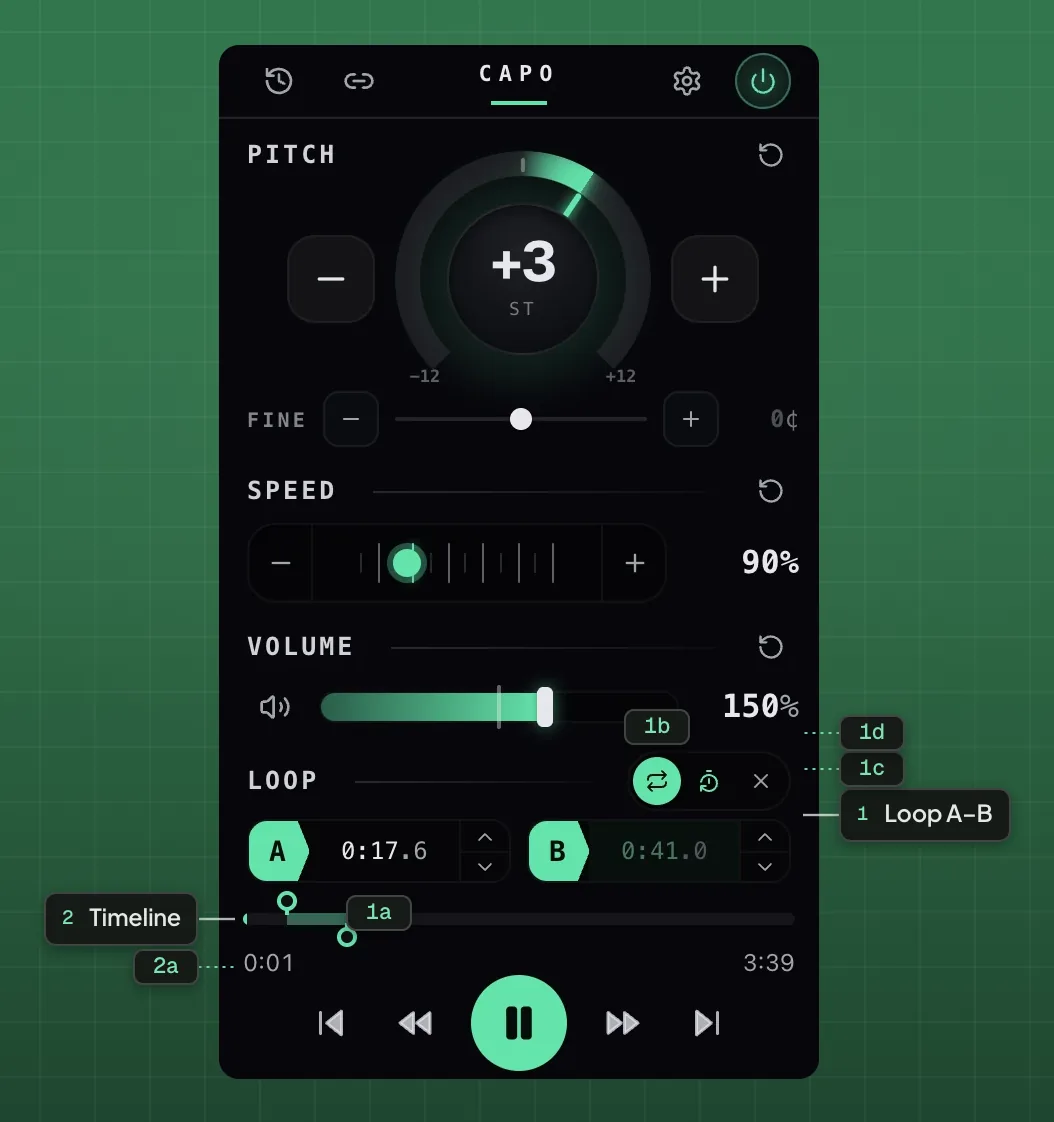
- 1Loop A–B
- 1aA / B points1bLoop on / off1cCount-in1dClear
- 2Timeline
- 2aA–B band
Why about a second is right
The count-in replays at every wrap from B back to A, so one attempt costs the count-in plus the loop. At 90 bpm a single beat is two thirds of a second, and the default count-in duration is 3 s — call it four seconds an attempt, or about fifteen a minute. Slowing down does not buy you more of them: the count-in is a wall-clock pause, so at 0.7× the beat itself stretches to about a second and the attempt gets slightly longer, not shorter. Drop the count-in to 2 s and you are back to roughly twenty. That density is the point: corrections stay in short-term memory between attempts, which is not true when a four-bar loop makes each repetition twelve seconds long.
Much shorter than a beat stops working. A half-beat loop gives no musical context, and you end up drilling a fragment you cannot place back into the phrase.
Slow it, but not as far as you think
Speed runs from 0.25× to 3×, and the instinct is to go to the floor. The useful window for learning a part is 0.6× to 0.8×. Below about 0.5× the pulse stops being felt as a pulse and you start playing a series of separate events instead of a phrase with a groove, which is a different skill and not the one you are building.
More on the speed control in slowing a video down without the chipmunk voice.
Loop the bar you keep missing.
A–B looping with count-in, on any site · freeWhere this stops helping
Bisecting finds where the problem is. It does not tell you what the problem is, and it will not help if the answer is a wrong fingering or a tempo beyond you today. If four cuts land on a beat that stays impossible at 0.6×, the loop has done its job and the answer is a different fingering.
It will not help with stamina, tone or intonation either. Those need long takes, not short loops.
A twenty-minute version
| Minutes | What you are doing |
|---|---|
| 0–2 | Play the phrase at full speed. Find roughly where it breaks. |
| 2–6 | Bisect down to about a beat. Four cuts. |
| 6–14 | Drill that beat at 0.7×, count-in on at its 3 s default. About fifteen attempts a minute. |
| 14–17 | Widen to the full phrase, still at 0.7×. |
| 17–20 | Full speed. Two or three takes, then stop. |
Questions
How wide should the first loop be?
Why does my loop feel impossible to play against?
Should I slow it down before or after narrowing?
How slow is too slow?
Does this work for singers too?
Keep reading
How to learn a song by ear without naming a single note
You do not need perfect pitch or theory. You need a slow loop, one string, and a way of asking the recording yes-or-no questions.
How to practise a passage faster when you hit a speed wall
Hitting the same wall daily is a sign, not a verdict. Usually the steps are too big, or you are drilling the wrong thing.
How to slow down a YouTube video without changing the pitch
Take any video down to a quarter speed to learn from it, while the pitch stays exactly where it was.