 Capo
CapoHow to play any song at 432 Hz, and what it actually changes
Reference tuning moves an entire track from one concert-pitch reference to another. Going from A = 440 Hz to A = 432 Hz is a shift of roughly minus 31.8 cents, about a third of a semitone. Capo Pro applies it in one control instead of making you calculate cents.
- Open the workspace and find Reference tuning.
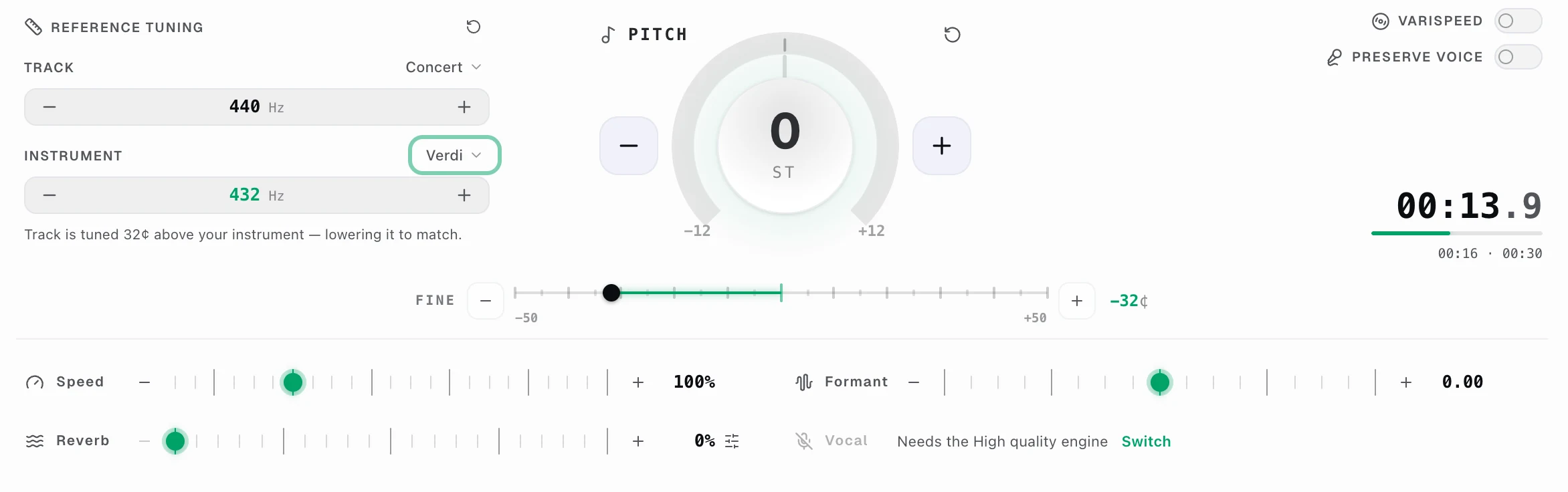
- Set the Track reference and your Instrument reference.
- Capo applies the difference in cents.
Concert pitch is a convention, not a physical constant. A = 440 Hz is the modern standard; orchestras and older recordings vary.
If you play with an instrument tuned to a different reference, everything clashes slightly. Reference tuning moves the recording instead.
Key takeaways
- 440 to 432 is about −31.8 cents, roughly a third of a semitone.
- Set both references and Capo computes the difference.
- Free alternative: the Fine control covers ±50 cents manually.
- It changes the pitch. It does not change anything else about the recording.
How many cents is 440 Hz to 432 Hz?
| From | To | Shift |
|---|---|---|
| A = 440 | A = 432 | −31.8 ¢ |
| A = 440 | A = 415 | −101.9 ¢ (about a semitone) |
| A = 440 | A = 442 | +7.9 ¢ |
A cent is one hundredth of a semitone, twelve hundred to the octave. Most listeners cannot identify a 32-cent shift in isolation.
Played against a tuned instrument, the same shift clashes audibly within a bar. Beating explains why.
How to set 432 Hz reference tuning
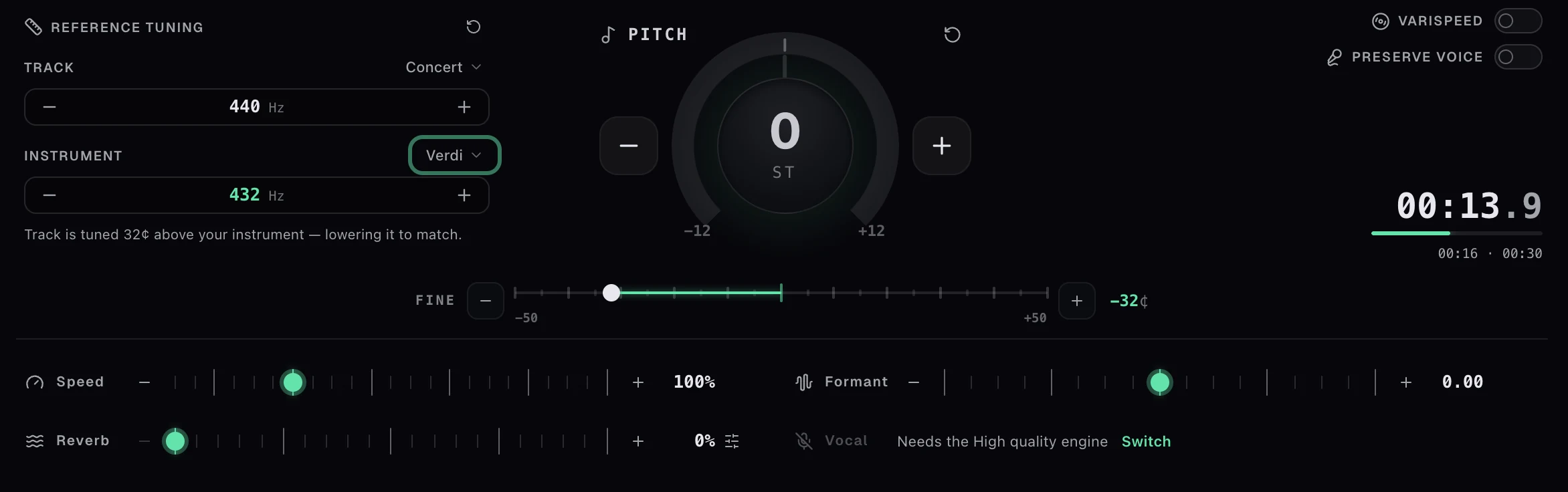
Track is what the recording was tuned to. Instrument is what you are playing at. The control applies the gap.
How to get 432 Hz without Pro
The free Fine control covers ±50 cents, which is enough for the common 440-to-432 move.
Set it to −32 and you are within half a cent of exact. See the free controls.
Does it sound better?
It sounds lower. Claims that 432 Hz is more natural or more healing are not supported by controlled evidence.
What is true: if you play alongside an instrument at a different reference, matching them removes a real and audible clash. That is a practical reason, and it is enough.
Is 432 Hz worth using?
Use reference tuning to match a recording to an instrument. Treat wider claims about 432 Hz with scepticism.
Questions
How many cents is 440 Hz to 432 Hz?
Can I do this without Pro?
Does 432 Hz have health benefits?
Why does a 32-cent shift clash so badly?
Keep reading
Why two guitars a few cents apart beat against each other
That slow wobble when two players are nearly in tune is not a metaphor. It has a frequency, and you can count it.
How to change pitch, speed and volume in your browser
A tour of every free control in Capo: the pitch dial, fine tuning, speed, volume and the A-B loop, with what each one is for.
Capo free vs Pro: what you keep after you close the tab
The free controls are not a trial. This sets out exactly where the line falls and who genuinely needs the workspace.